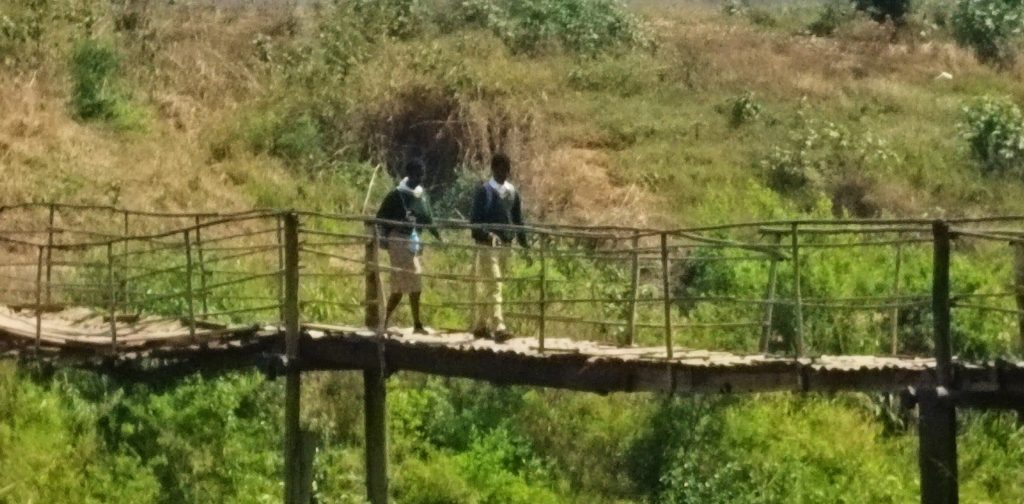
For three years, Maxwell Thomas, 33, has earned a living by charging people crossing Lingadzi River between Area 47 and 49 in Lilongwe.
Every day, he collects K100 from each person crossing a 30-metre makeshift footbridge, counting about K25 000 by sunset.
From around K750 000 monthly ‘toll fees’, his employers pay him a K100 000 salary and pocket the remainder.
That income helps Thomas support his wife and a two-year-old child. He also owns a pushbike that carries people and goods at a cost.
However, the construction of a Bailey bridge within metres of his 30-metre wooden affair threatens that income.
Predictably, Thomas is already contemplating life beyond the 10 metre-high crossing.
“I have started thinking about another way to earn a living. Once the new bridge is completed, people will no longer need to pay me to cross here,” he says.
Thomas’ uncertainty contrasts with the optimism of Mkwichi Secondary School students.
The Bailey bridge project will reduce the cost of getting to school for learners from Area 49, who spend K1 000 a week crossing the makeshift bridge to and from school in Area 47.
They envisage the out-of-pocket expense will disappear once the Bailey bridge opens.
“I will use the savings on things that I need at school without constantly asking my parents,” says Form Three student Loveness Mpangowalimba.
Her Form Two schoolmate, Edson Ali, sees himself saving K4 000 monthly for his needy household to meet other basic needs.
“If we stop paying to cross Lingadzi, my parents can use that money for other needs in the family,” he says.
The students’ experience illustrate how gaps in public infrastructure can impose recurring costs on people trying to access essential services.
The planned bridge and 800 metres of bitumen road connecting to the Presidential Way near Bingu National Stadium in the capital city are envisioned to improve access between the residential areas and Lilongwe City Centre.
Minister of Local Government and Rural Development Ben Malunga Phiri says congested roads affect city residents, with workers and businesspersons delaying to reach their workplaces.
“Many residents of locations across the river experienced challenges to get to town. This new link will provide an alternative route towards town while reducing pressure on existing roads,” he said in an interview after launching the establishment of the bridge on Friday.
Lilongwe City Council chief executive officer Clement Stambuli says the capital city’s infrastructure “does not befit that status”.
For students and residents, the Area 47-49 bitumen road offers free access to education and basic services.